recent paintings // 2026
Baldwin’s use of sharp edges and flat color areas evokes abstractions with a captivating presence.
The formal possibilities are enticing, and he refers to his results as hard-edge impressionist landscapes, a fresh minimalist form.
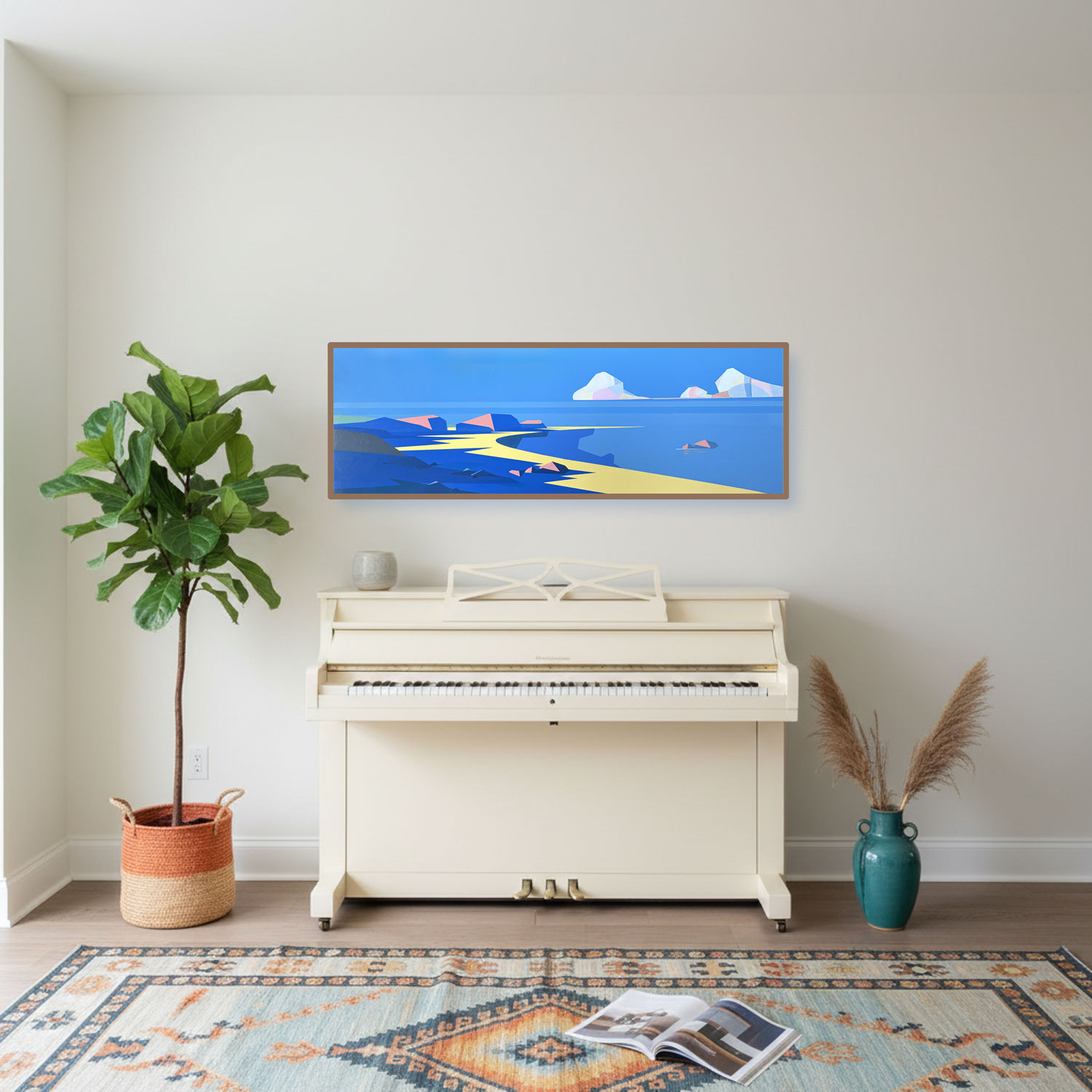
In the case of Yellow Beach, at right, from his Origami Cloudscapes series, Baldwin walks a line evocative of realism yet with confindent freedom from those rules. His design dictum, “geometry does not have to make sense,” is evident, leading the eye through the forms. At the last, the viewer’s gaze finds the emblematic center of the image, a lonely rock afloat in its own reflection.
Acrylic on canvas, 36 in W x 12 in H. Artist’s collection.

Of his current series, Origami Cloudscapes, Baldwin says that a big part of the experience is emptiness, a void so complete that he feels the shadows draw away as the sun moves through an empty sky. “My eye hits Confetti Sky (at left) makes a fast scan, then goes to the most remote, emptiest part of the canvas.”
For this artist that emptiness creates the captivating presence. “Those are the palaces of dreams.”
Baldwin loves the poetry of land forms for their expression of isolation. Artistically, this is a key factor that separates his artwork from other traditions of painting, as here, the aim is not to illustrate by shapes and forms, but to capture a felt sense of hidden possibilities.
Acrylic on canvas, 36 in W x 18 in H. Artist’s collection.
In his Darkening Thunder, pictured at right above an old piano, Baldwin sculpted the line work while allowing the perspective to guide the viewer’s eye.
This shaping, Baldwin feels, lets the eye move at its own pace while seeking equilibrium.
Acrylic on canvas, 36 in W x 18 in H. Artist’s collection.


This image of Stockton Bridge in Capitola, California uses sharp edges and random shapes to suppress reality, and evoke an impression of the popular destination. There is no shading of the paint, but areas of flat color provide tonal variations which strengthen with distance.
Acrylic on Canvas, 40 in W x 30 in H, framed.
Artist’s collection.
In his Infinite Theatre, at right, Baldwin created the cloud forms with only four colors, painting them flat within sharp edges to tease out the sense of volume. The fading saturation creates depth through atmospheric perspective.
This shaping, Baldwin feels, lets the eye move at its own pace while seeking equilibrium.
Acrylic on Canvas, 30 in W x 24 in H. Private Collection, Hillsboro, Oregon.


One of the early canvases in his hard-edge impressionism style, Kehena Shorebreak is Baldwin’s recollection of Kehena Beach on Big Island, Hawaii. This image uses the crisp-edged areas of flat color to fool the eye into perceiving shading and volume.
Acrylic on canvas, 36 in W x 12 in H, gallery wrap.
Artist’s collection.
In his Etude, Origami Cloudscapes, at right, Baldwin created the cloud forms from layers of glazing and overpainting, not painting them flat as before, but introducing small blended sections.
Baldwin likes this type of shaping for the way it lets light play among the forms.
Acrylic on Canvas, 11 in W x 14 in H. Private collection, Portland Oregon.


A canvas belonging to his Origami Cloudcapes series, Shape Calling Form is an arrangement of shapes in the landscape and forms in the sky. It’s a way to play with shading, depth, and volume.
Acrylic on canvas, 18 in W x 22 in H, framed. Private collection, Portland, Oregon.
In his Strutting Clouds, at right, is a use of both glazing and hard-edge styles.
Baldwin likes this type of shaping for the way it lets light play among the forms.
Acrylic on Canvas, 20 in W x 24 in H.
Artist’s collection.


A singular canvas, Birthplace of Lightning is a 3D treatment of cloud forms mounting over planar forms in the foreground land mass. It’s a way to play with the solidity of volume, along with shading and depth.
Acrylic on canvas, 18 in W x 36 in H, gallery wrap. Private collection, Seattle, Washington.
Here, Migrating Papaya Skins is a simple use of water-soluble oils to create a connection of blended surfaces.
This is a straightforward example of subtle highlights and shadow cast.
Acrylic on Canvas, 20 in W x 24 in H.
Private Collection, Seattle, Washington.


Contemplation of Eternity presents a bare experience of space and desolation.
Acrylic on canvas, 36 in W x 12 in H, gallery wrap. Lost in a fire.
Prussian Winter is a voluptuous intersection of surfaces.
Using blending and smearing with water-soluble oils, this painting used as reference a canvas by Canadian Group of Seven artist Lawren Harris. While Harris’s is in natural colors, Baldwin confined his palette to Prussian Blue, Ivory Black, and Titanium White
Acrylic on Canvas, 24 in W x 19 in H.
Artist’s collection.

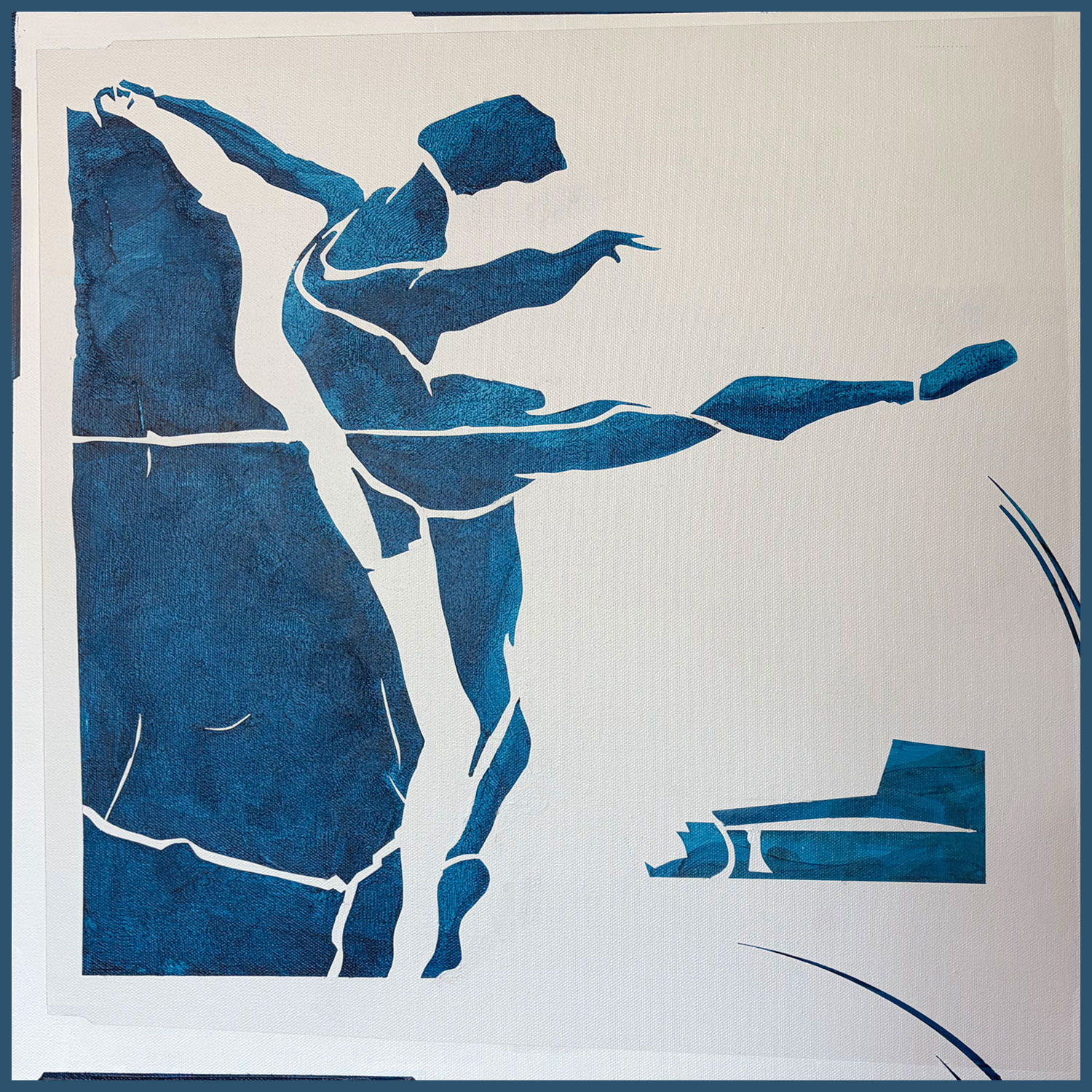
Fragments: Ballet Dancer
Abstraction of human form, a monochromatic movement study. The composition uses negative space to delineate the anatomy, posture, and movement of the subject. By fragmenting the form into distinct, hard-edged color fields, the painting bypasses realistic portrayal to call forth a sense of energy and momentum. The resulting visual relies on geometric reduction to communicate physical tension rather than on surface detail.
Acrylic on canvas, 20 in W x 20 in H, gallery wrap.
Artist’s collection.
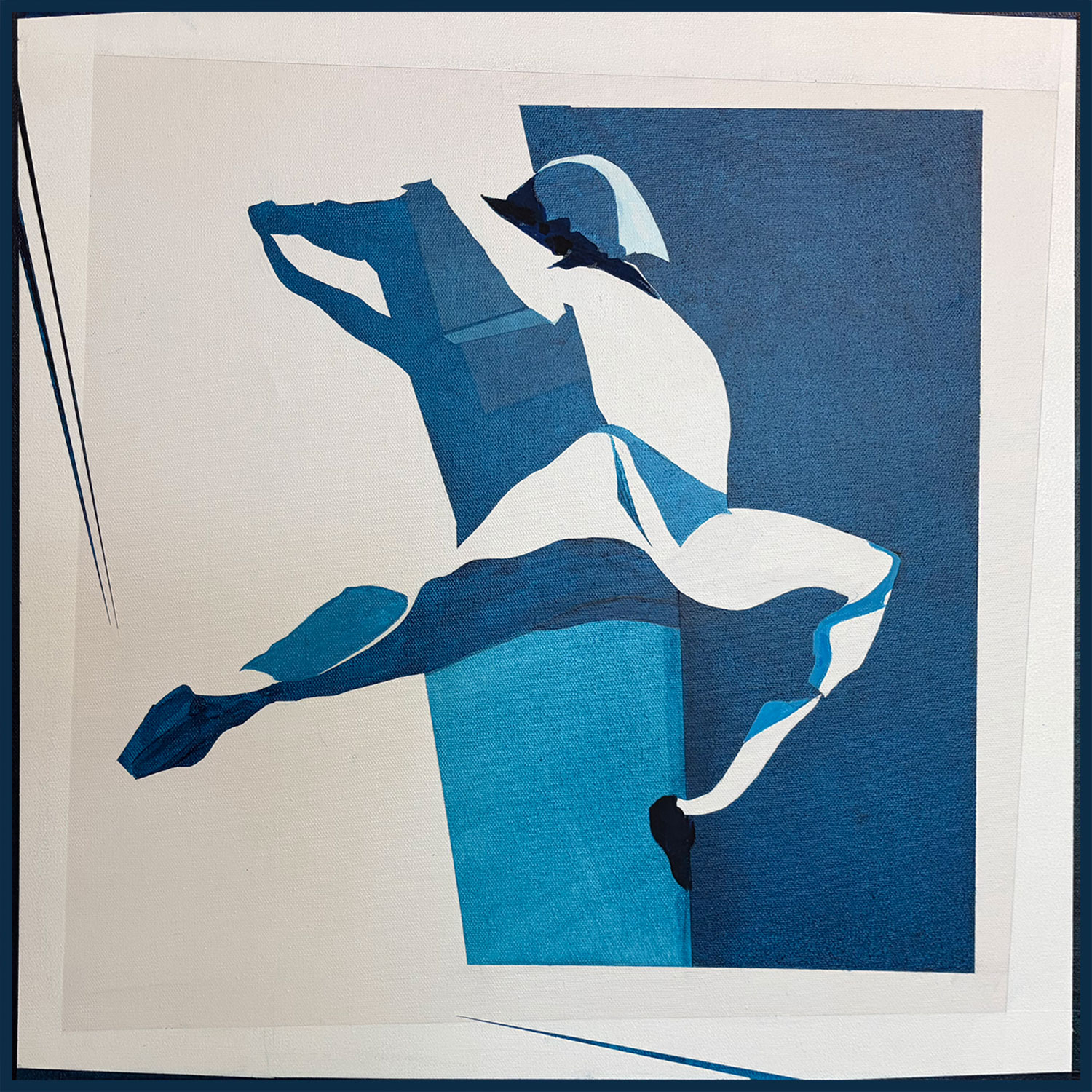
Fragments: Propulsion
Hard-edged shapes delineate a figure suspended in a leap. Fluid figure-ground relationships use the unpainted white canvas as the subject’s mass while anchoring it within interlocking geometric planes. The isolation and fragmentation of shadows and limbs discards literal interpretation, prioritizing physical tension and the kinesthetic sense of propulsion.
Acrylic on Canvas, 20 in W x 20 in H.
Artist’s collection.
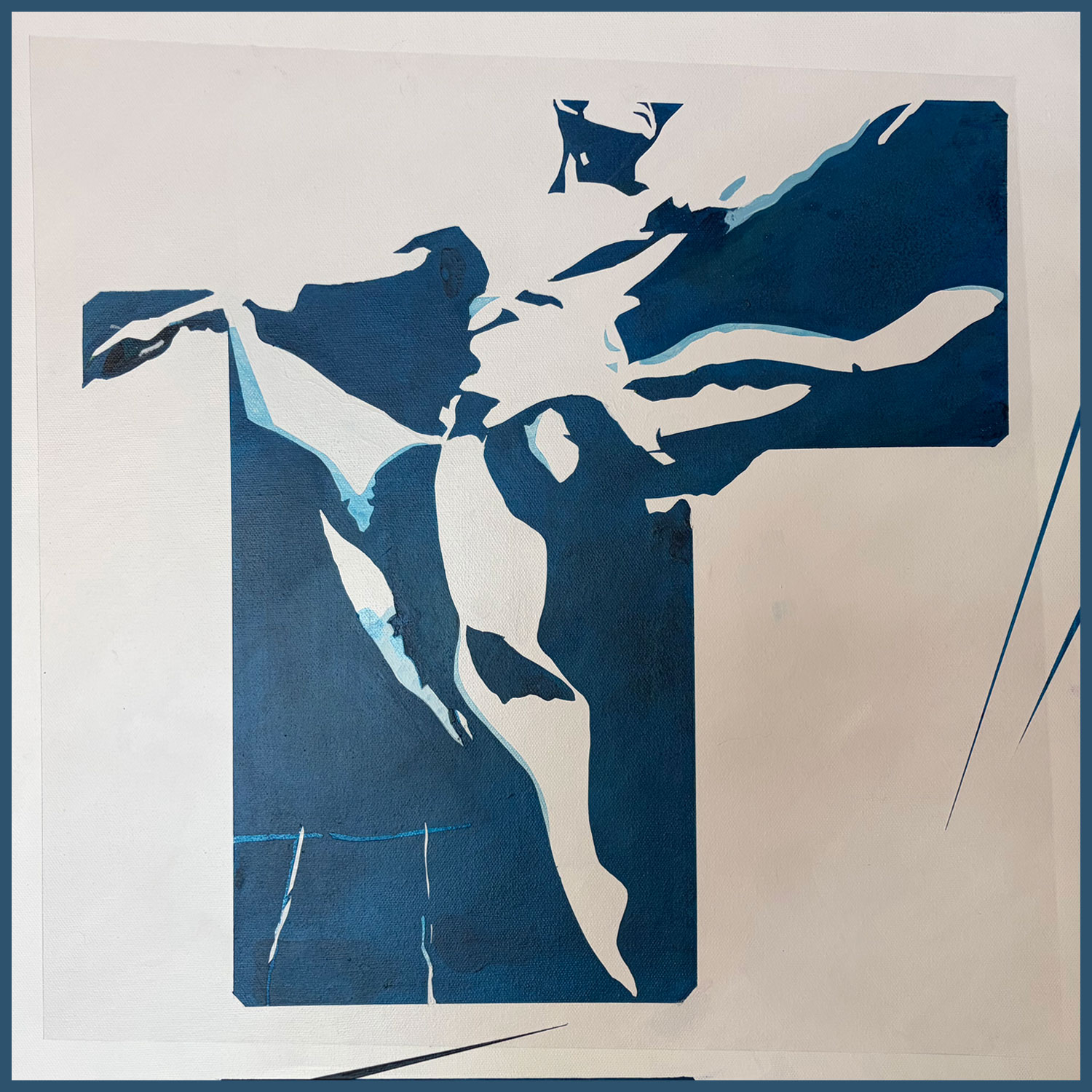
Fragments: Baryshnikov
Monochromatic abstraction of human form, a twirling body wrapped in tension. The structural thesis is that geometry does not have to make sense, and from flexible figure-ground relationships, the mind perceives elements not actually drawn. The painting avoids realistic portrayal to impart felt momentum. This geometric reduction communicates physical tension in space rather than literal figurative detail.
Acrylic on canvas, 20 in W x 20 in H, gallery wrap.
Artist’s collection.
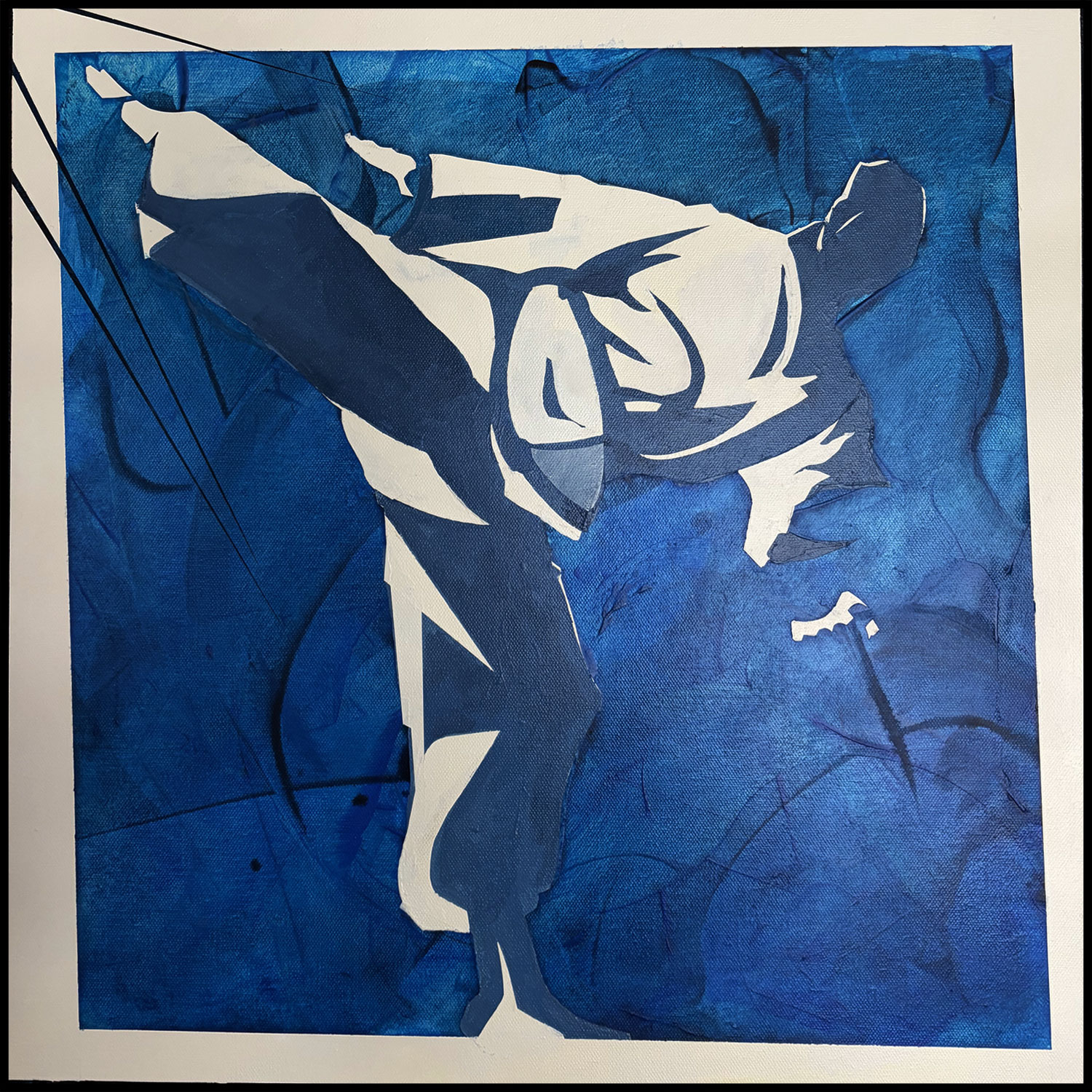
Fragments: Kick Boxer
Aginst a background of the lambent field, these hard-edged shapes delineate a figure suspended in a leaping kick. Fluid figure-ground relationships allow personal interpretation and a felt presence. The isolation and fragmentation of shadows and limbs discards literal interpretation, prioritizing physical tension and the kinesthetic energy explosion.
Acrylic on Canvas, 20 in W x 20 in H.
Artist’s collection.
–>